

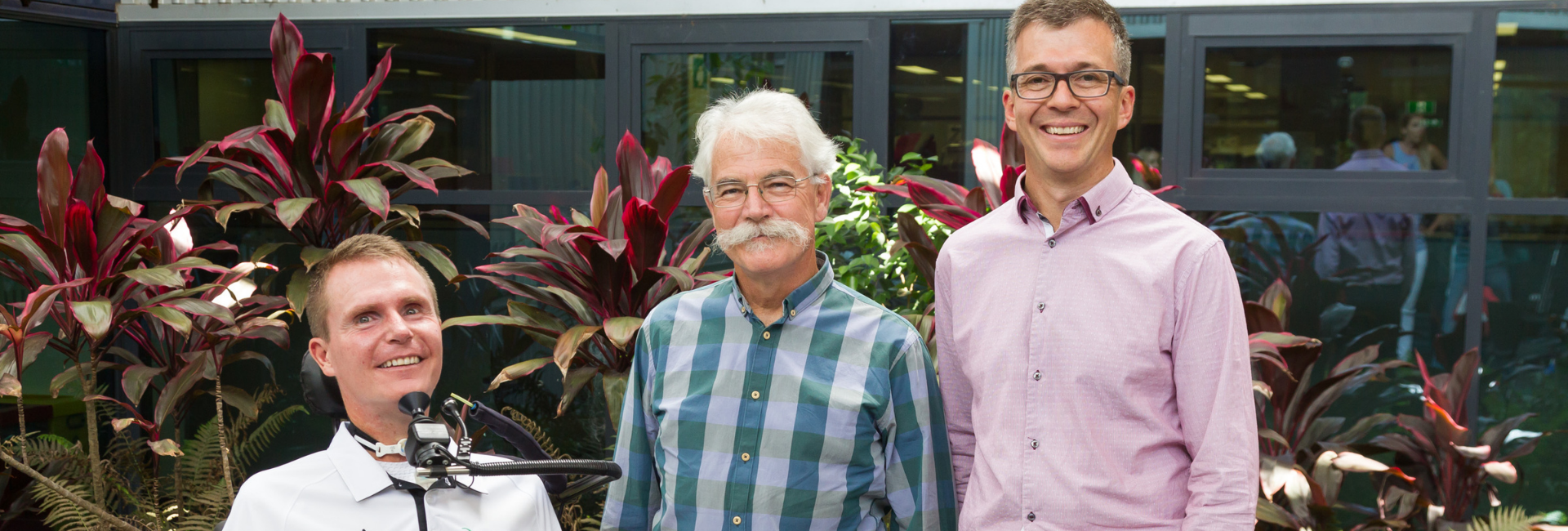
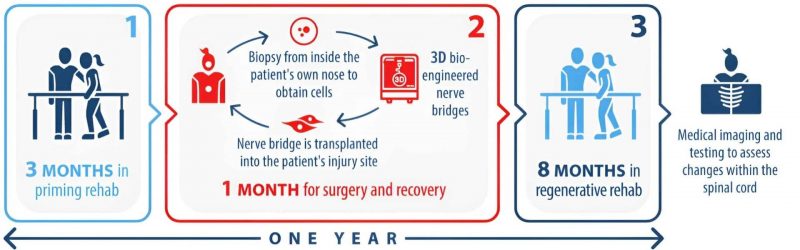
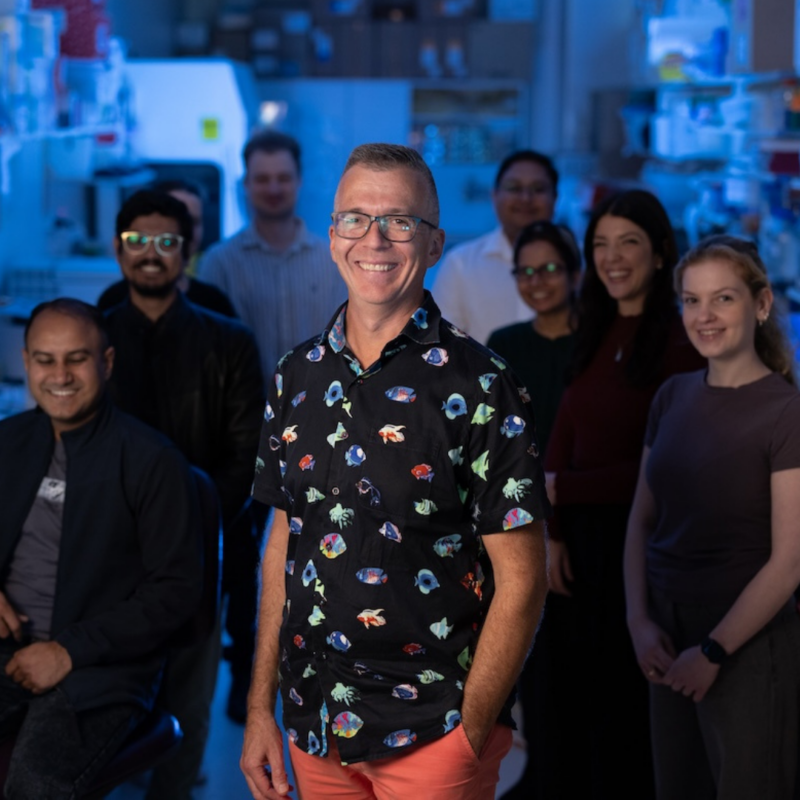
The Nerve Bridge Transplantation and Rehabilitation Human Clinical Trial is a world-first endeavour, and the culmination of more than a decade of dedicated spinal cord injury research at Griffith University’s Clem Jones Centre for Neurobiology and Stem Cell Research. Directed by Professor James St John, the trial tests the safety and efficacy of transplanting a patient’s own olfactory cells, taken from a simple nasal biopsy, into the injured spinal cord via a specially engineered nerve bridge, combined with a long-term intensive rehabilitation program. Thirty participants will take part, with twenty receiving the full nerve bridge transplantation and rehabilitation program and ten completing the rehabilitation program alone.
The Spinal Injury Project at Griffith University has a team of internationally recognised, award winning, researchers based in state-of-the-art laboratories at the Gold Coast and Nathan campuses. The team includes bioengineers, medical doctors, biological scientists and educators who have worked together to bring this breakthrough treatment from preclinical research to human trial. The research was first initiated by the late Emeritus Professor Alan Mackay-Sim, a pioneer in stem cell research who demonstrated that olfactory cells could be transplanted safely to a spinal cord injury site. Building on Professor Mackay-Sim’s incredible legacy, Professor St John and his team developed the nerve bridge technology that underpins the trial today.
If you or someone you know is living with a spinal cord injury and would like to find out more about participating in the trial, you can register your interest directly with the Griffith University team.
Laying the groundwork
Before the human trial could begin, PCSRF worked with the Griffith University team to de-risk the path forward. The Foundation directly funded two rehabilitation clinical trials (and many more pre-clinical work that can be found on our funded projects page) and purchased an advanced LiveCyte microscope for cell safety testing, each of which were essential steps in building the evidence base and infrastructure the human trial depends on.
The first rehabilitation trial involved participants with prior experience in rehabilitation programs, though not at the intensity required for the trial. Results confirmed that the intensive long-term rehabilitation program is safe, and that participants responded positively to both the program and the peer support it offered. PCSRF fully funded this trial at a cost of $450,000 for five participants.
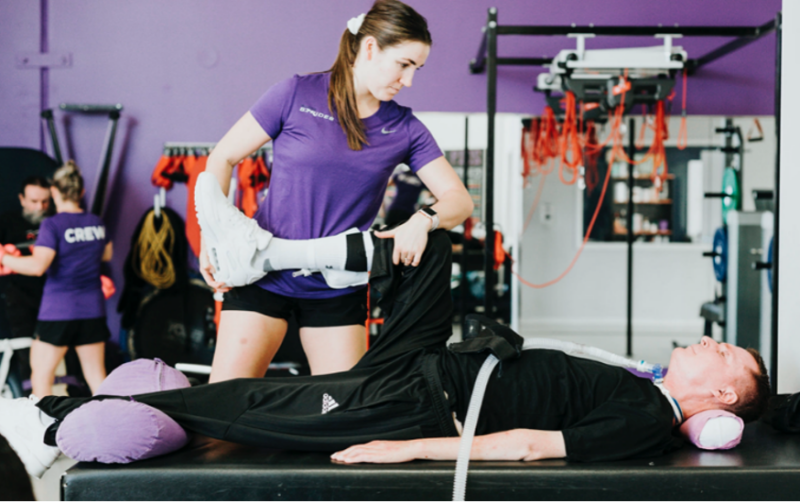
The second rehabilitation trial extended this work to participants with little prior experience in intensive rehabilitation, demonstrating that this group could also safely complete the program. Together, these two trials gave the research team the confidence to proceed. PCSRF fully funded this trial at a cost of $420,000 for five participants.
Safety is a priority for the trial, and for this reason PCSRF funded the LiveCyte microscope for the research team. This microscope uses live-cell imaging to track the fate of cells being viewed, allowing researchers to confirm cells are behaving appropriately and that no undesirable cells are present in the population. This technology is of immense importance for safety screening in cell transplantation therapies. The LiveCyte microscope was funded in full by the Foundation through the support of our donors at a cost of $400,000.
You can read more about each of these projects in our funded research projects library.
Building the best research team in the world
A world-first trial needs a world-class team. Alongside funding the trial itself, the Foundation is committed to raising $1.7M to recruit, develop and retain the very best researchers t, these same team members working to optimise the therapy are also part of trial delivery. You can read more about this commitment on our Best Research Team funded project page.
Funding the trial
Through generous supporters like you, our funding partners, philanthropists, and our incredible fundraising community, the Foundation initially helped to raise the $8.5M needed to commence the trial for 15 participants.
The total direct commitment from PCSRF is $5.4M, which includes a $2M contribution from Queensland Health and $1M from Nicola and Andrew Forrest. The remaining $3.1M has been generously donated by The Clem Jones Foundation, Griffith University, The Brazil Family and Terry and Rhonda White. The Foundation also played a key role in advocating for broader government and institutional support, which was critical in bringing the full funding picture together.
Professor James St John and his team were subsequently awarded a Medical Research Future Fund Stem Cell Therapies Grant of $6.8M for the clinical trial. With this funding, the trial expanded to thirty participants at a total cost of $15,300,000.
Future breakthroughs will depend on continued community support. Through major partnerships and the collective impact of many smaller contributions. By donating today, you can help make the next generation of life-changing spinal cord injury research possible.